


The Copenhagen Psychosocial Questionnaire (COPSOQ) is a globally recognized scientific instrument, fundamental for assessing work organization and managing psychosocial risks. It measures workers' perceptions of their routines, cognitive and emotional demands, relationships with management, and potential symptoms of stress and burnout.

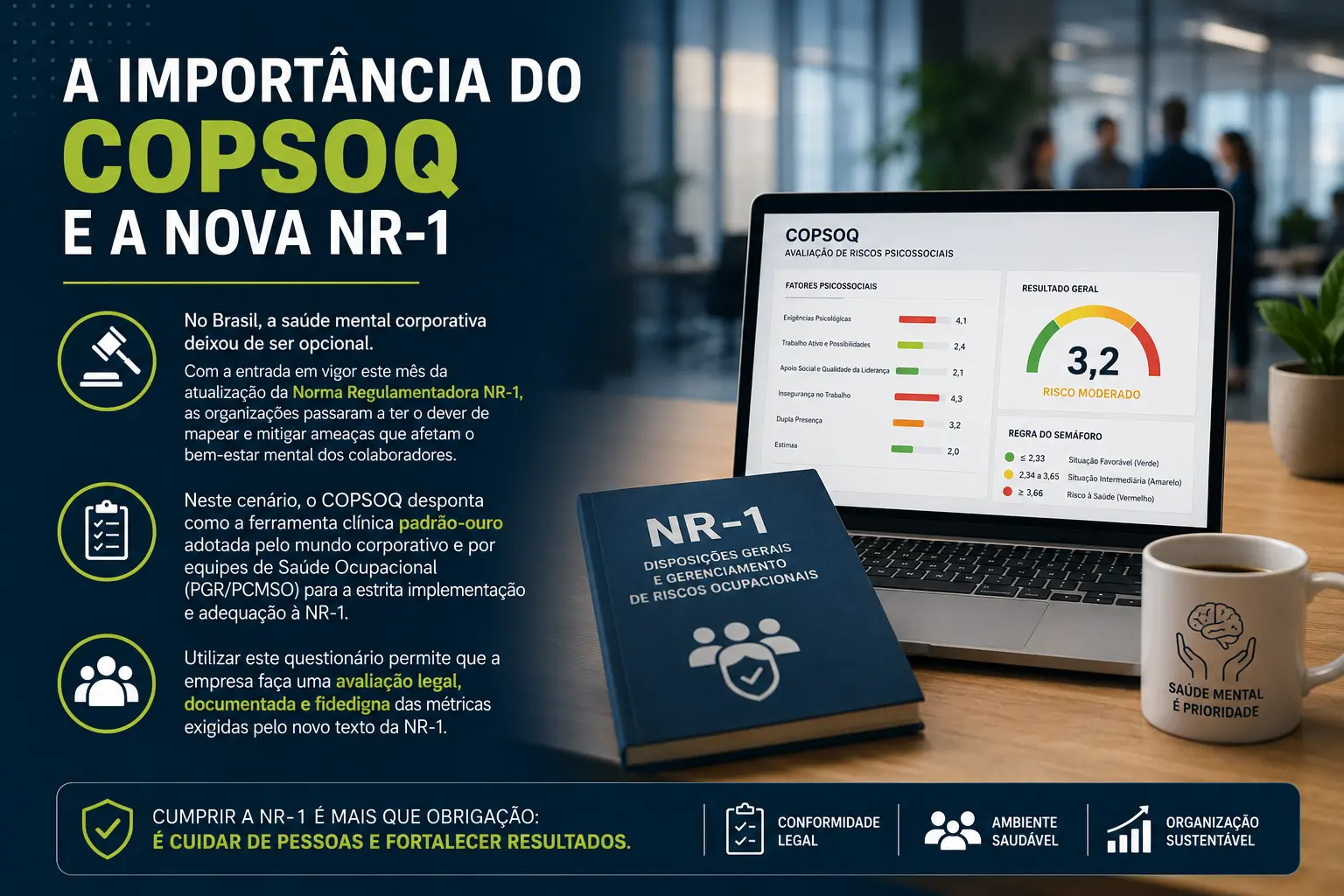
The Importance of COPSOQ and OSHA/NIOSH Guidelines
In the United States, corporate mental health and workplace wellness are no longer optional. With increasing emphasis from the Occupational Safety and Health Administration (OSHA) and the integration of the NIOSH Total Worker Health® framework, organizations have a duty to map and mitigate threats that affect employees' mental and physical well-being.
In this scenario, COPSOQ emerges as the gold-standard clinical tool adopted by the corporate world and Occupational Health teams for strict implementation and workplace safety compliance. Using this questionnaire allows companies to conduct a legal, documented, and reliable assessment of the metrics required for maintaining a healthy work environment.
The 3 Versions of the Questionnaire and Their Differences
COPSOQ (currently in its second and third clinical iterations) was structured in a versatile manner to adapt to different needs. It has three main versions:
- Short Version (41 Questions): Intended for quick self-assessments, screenings in small workplaces, and periodic check-ups. It measures the general stress landscape in an agile and objective way.
- Medium Version (76 Questions): The standard for occupational health professionals. It evaluates risks in detail, assisting in planning and corporate audits.
- Long Version (119 to 148 Questions): The most exhaustive tool, designed primarily for rigorous scientific research, deep leadership mapping, and clinical burnout diagnosis.
And what changed in the transition from COPSOQ II to COPSOQ III?
The mathematics and the backbone remained the same, but COPSOQ III was modernized for the challenges of the current decade. Crucial new psychosocial factors were included, such as the assessment of Cyber Bullying, Illegitimate Tasks, job insecurity, and organizational engagement metrics.
Step by Step: How to Calculate the COPSOQ Score
To ensure the questionnaire isn't just a "bunch of opinions", the tool converts emotions into quantitative data. Learn below how to extract the results and understand the "traffic light rule" in an extremely didactic way:
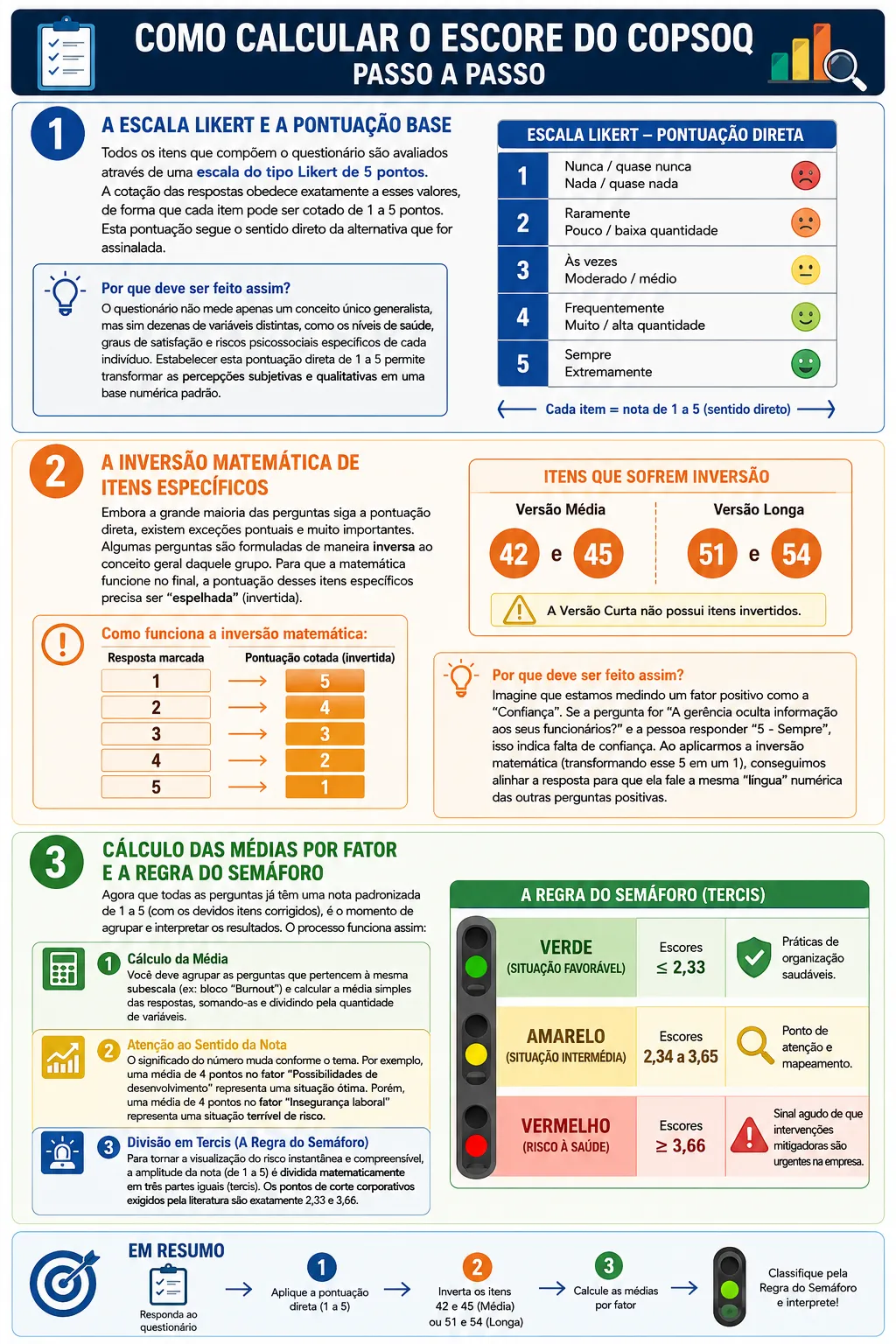
1 The Likert Scale and Base Scoring
All items that make up the questionnaire are evaluated using a 5-point Likert scale. The scoring of the answers strictly follows these values, meaning each item can be scored from 1 to 5 points. This score follows the direct meaning of the selected alternative. For example, responses range from "1 - Never/hardly ever" to "5 - Always", or from "1 - To a very small extent" to "5 - To a very large extent".
Why must it be done this way? The questionnaire does not measure a single general concept, but rather dozens of distinct variables, such as health levels, satisfaction degrees, and specific psychosocial risks for each individual. Establishing this direct 1 to 5 score allows transforming subjective and qualitative perceptions into a standard numerical baseline.
2 Mathematical Inversion of Specific Items
Although the vast majority of questions follow the direct scoring seen in Step 1, there are specific and very important exceptions. Some questions are formulated in reverse to the general concept of that group. For the math to work out in the end, the score of these specific items needs to be "mirrored" (inverted).
How mathematical inversion works:
• If the person selected 1, the calculated score will be 5.
• If the person selected 2, the calculated score will be 4.
• If the person selected 3, the calculated score remains 3.
• If the person selected 4, the calculated score will be 2.
• If the person selected 5, the calculated score will be 1.
According to the COPSOQ II manual, in the Medium Version, the only items that undergo this inversion are 42 and 45. (In the Long Version, they correspond to items 51 and 54. The Short Version does not have inverted items).
Why must it be done this way? Imagine we are measuring a positive factor like "Trust". If the question is "Does the management withhold information from its employees?" and the person answers "5 - Always", this indicates a lack of trust. By applying the mathematical inversion (transforming that 5 into a 1), we can align the answer so it speaks the same numerical "language" as the other positive questions.
3 Calculating Averages by Factor and the Traffic Light Rule
Now that all questions have a standardized score from 1 to 5 (with the necessary items corrected), it's time to group and interpret the results. The process works like this:
Calculating the Average: You must group the questions that belong to the same subscale (e.g., the "Burnout" block) and calculate the simple average of the answers by summing them up and dividing by the number of variables.
Attention to the Score's Meaning: The meaning of the number changes depending on the topic. For instance, an average of 4 points in "Possibilities for development" represents an optimal situation. However, an average of 4 points in "Job insecurity" represents a terrible risk situation.
Division into Terciles (The Traffic Light Rule): To make the visualization of risk instantaneous and understandable, the score range (from 1 to 5) is mathematically divided into three equal parts (terciles). The corporate cut-off points required by the literature are exactly 2.33 and 3.66.
- GREEN (Favorable Situation): Scores less than or equal to 2.33. Healthy organizational practices.
- YELLOW (Intermediate Situation): Scores between 2.34 and 3.65. Attention zone; requires mapping.
- RED (Health Risk): Scores equal to or greater than 3.66. Acute sign that mitigating interventions are urgently needed in the company.
Accelerate Your Occupational Health Compliance (OSHA)
Calculating dozens of questions manually and performing mathematical score inversions can lead to serious errors in your company's reports. To solve this, we developed semi-automated COPSOQ calculators on our website.
Access it, answer the questions, and click "Calculate" so our system applies the entire traffic light metric instantly. Best of all: you can generate a PDF report document in perfectly framed A4 format to save and attach to corporate records!